
No products in the cart.
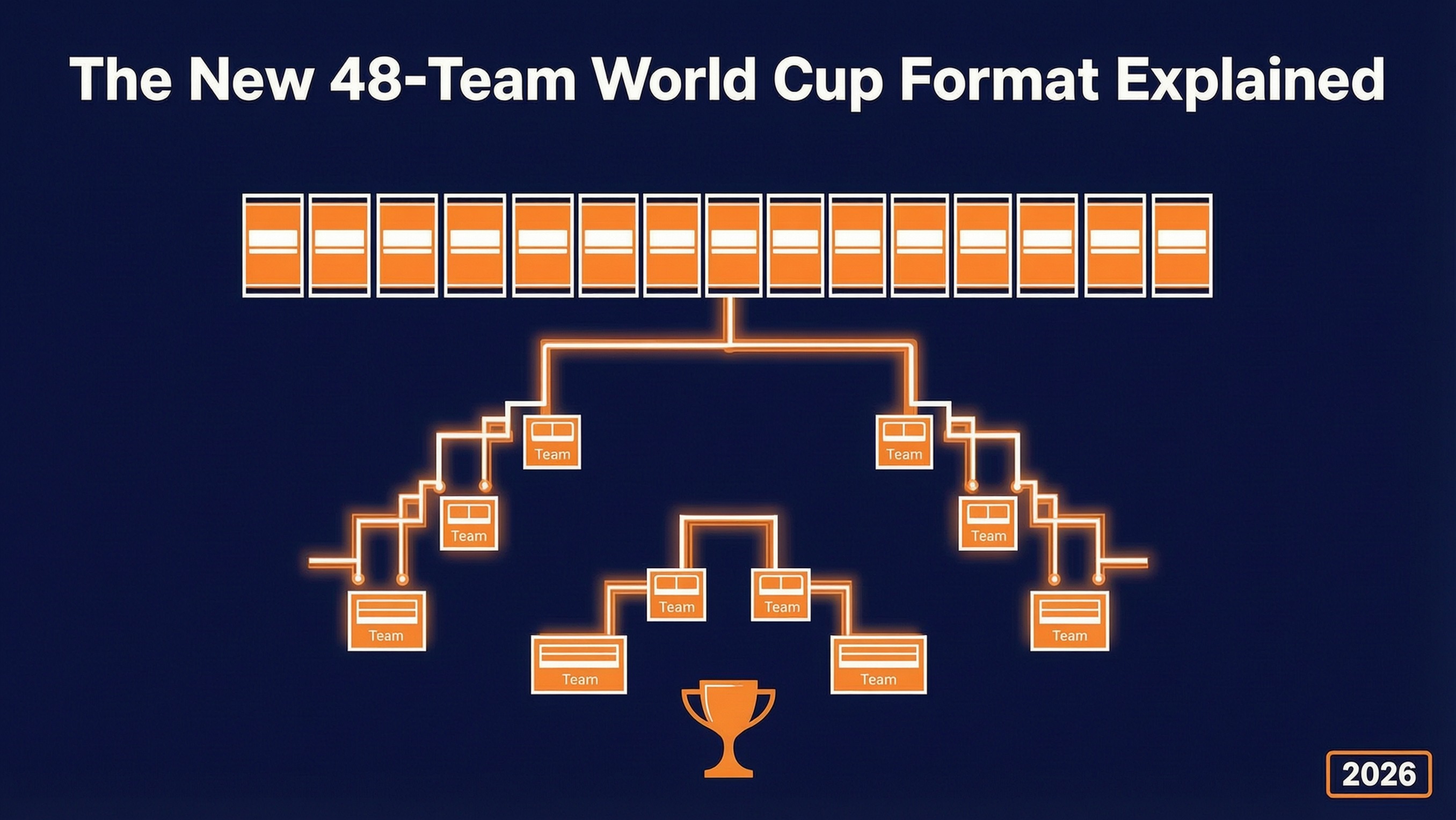
If you’ve been trying to follow the 2026 FIFA World Cup format and found yourself confused, you’re not alone. For the first time since 1998, the tournament has a completely new structure — and it’s bigger than anything we’ve seen before. This guide breaks down exactly how it works, why FIFA changed it, and what it means for teams, fans, and the drama of the competition.
📋 In this article
What Changed — 48 Teams Instead of 32
The 2026 FIFA World Cup format marks the most significant structural change in the tournament’s history. Since France 1998, the World Cup featured 32 teams in 8 groups, producing 64 matches and a Round of 16 as the first knockout stage. In 2026, that changes entirely.
The expanded tournament features 48 teams — a 50% increase — playing 104 matches across 16 venues in the United States, Mexico, and Canada. This is the first edition co-hosted by three countries and the first to feature this many nations competing on football’s biggest stage.
| Feature | Qatar 2022 (old format) | 2026 (new format) |
|---|---|---|
| Teams | 32 | 48 |
| Groups | 8 groups of 4 | 12 groups of 4 |
| Total matches | 64 | 104 |
| First knockout round | Round of 16 (16 teams) | Round of 32 (32 teams) |
| African teams | 5 | 10 |
| Prize money (winners) | $42 million | $50 million |
How the Group Stage Works
The 2026 FIFA World Cup format keeps the traditional four-team group structure but expands to 12 groups instead of 8. Every team plays three group stage matches — one against each opponent in their group.
Points are awarded in the standard way: 3 for a win, 1 for a draw, 0 for a loss. At the end of the group stage, the teams are ranked within each group by points accumulated.
The following teams advance from the group stage to the Round of 32:
- The top two teams from each of the 12 groups (24 teams total)
- The eight best third-placed teams across all 12 groups (8 teams)
- Total: 32 teams advance to the knockout phase
💡 What this means in practice
Even a team that finishes third in their group can still qualify — as long as their points tally is better than the other third-placed teams from other groups. This creates more drama on the final matchday and keeps more teams alive deeper into the group stage.
The New Round of 32 Explained
This is the biggest structural change in the 2026 FIFA World Cup format. Instead of the old Round of 16, the first knockout phase is now a Round of 32 — an entirely new stage that has never appeared in World Cup history before.
In the Round of 32, the 32 qualified teams are paired into 16 single-elimination matches. Lose, and you’re out. Win, and you advance to the Round of 16. The specific pairings depend on group positions and which third-place teams advance — the structure is designed to separate teams from the same group and avoid rematches too early in the knockout phase.
The Full Knockout Path to the Final
From the Round of 32 onwards, the 2026 FIFA World Cup format follows straightforward single-elimination football. Every match from this point is a knockout — lose, and the tournament is over.
- Round of 32: 32 teams → 16 winners advance (late June 2026)
- Round of 16: 16 teams → 8 winners advance
- Quarter-finals: 8 teams → 4 winners advance
- Semi-finals: 4 teams → 2 finalists (AT&T Stadium, Dallas and Mercedes-Benz Stadium, Atlanta)
- Third-place play-off: Hard Rock Stadium, Miami
- The Final: MetLife Stadium, New York/New Jersey — 19 July 2026
If a knockout match is level after 90 minutes, it goes to 30 minutes of extra time. If still level, the match is decided by a penalty shootout.
How Tiebreakers Work
When two or more teams finish level on points within a group, FIFA applies tiebreakers in the following order under the 2026 FIFA World Cup format:
- Goal difference — goals scored minus goals conceded across all group matches
- Goals scored — the team with more total goals ranks higher
- Head-to-head results — points, goal difference, and goals scored in matches between the tied teams
- Fair play ranking — fewer yellow and red cards across group matches
- Drawing of lots — as a last resort, a random draw is used
For the eight best third-placed teams, FIFA ranks all 12 third-place finishers by points, then goal difference, then goals scored to determine which eight advance.
Why the Expanded Format Matters
The 2026 FIFA World Cup format change was driven by FIFA President Gianni Infantino’s goal of making the tournament truly global. Expanding from 32 to 48 teams means more confederations get more spots — Africa goes from 5 to 10 teams, Asia and CONCACAF also see significant increases.
Critics have raised questions about whether the expansion dilutes quality in the group stage, but the knock-on effects are significant. More matches means more broadcasting revenue, more prize money (the winning team collects a record $50 million), and crucially, more nations with a genuine shot at tournament football’s biggest stage.
“The World Cup should represent the whole world.” — Gianni Infantino, FIFA President
For a full visual breakdown of the format, Al Jazeera’s World Cup explainer is an excellent resource. You can also follow live standings and fixtures on the official FIFA website.
💡 Watching all 104 matches?
Gate2Enter stocks streaming subscriptions so you can follow the full 2026 FIFA World Cup format from group stage to final — browse at gate2enter.com.
Was this helpful?